
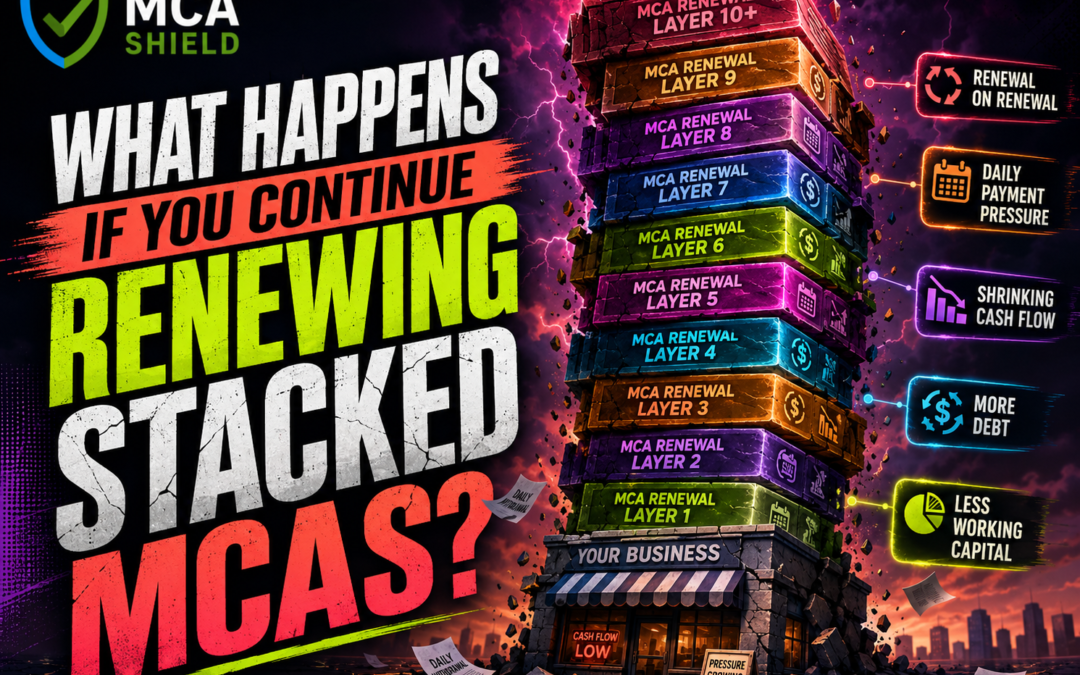
Renewing stacked MCAs can feel like a quick way to keep cash moving when your business is under pressure. However, repeated renewals can create a cycle where new funding is used to support old obligations. Over time, this can increase daily payment pressure and leave less money available for normal operations.
As the number of advances grows, your business may have to manage multiple ACH withdrawals, shrinking working capital, payroll demands, vendor bills, and other operating expenses at the same time. What begins as short-term relief can turn into a much larger cash-flow problem.
Understanding what happens when you continue renewing stacked MCAs can help you recognize the warning signs early. It can also help you decide whether another renewal makes sense or whether MCA restructuring or consolidation may provide a more sustainable path forward.
Schedule Your Free Consultation
What Happens When You Keep Renewing Stacked MCAs?
When a business keeps renewing stacked MCAs, the financial pressure can build quickly. Each new renewal may provide access to additional cash, but it can also add another obligation to an already crowded payment schedule.
Instead of solving the underlying cash-flow problem, repeated renewals may simply move it forward. The business receives new funding, uses part of it to cover existing obligations, and then faces another round of daily or weekly MCA payments.
Over time, this cycle can reduce the amount of cash available for payroll, inventory, vendors, taxes, rent, and other operating expenses. The business may remain open and generating revenue, but more of that revenue is committed before it can be used for normal operations.
How MCA Renewals Can Extend the Debt Cycle
An MCA renewal often occurs before the original advance has been fully paid off. In some cases, part of the new advance is used to satisfy the remaining balance, while the business receives the rest as additional working capital.
This can create a pattern where the business is replacing one MCA obligation with another instead of eliminating the debt. If several advances are already active, the problem can become even more difficult.
For example, a business may renew one MCA while continuing to make payments on two or three others. The new advance adds fresh funding, but it also creates another payment obligation. As this continues, stacked MCA debt can become harder to unwind.
The cycle may look like this:
Cash shortage → MCA renewal → temporary cash injection → continued withdrawals → another cash shortage → another renewal
If revenue does not increase enough to support the growing payment burden, the business may become increasingly dependent on new funding just to maintain normal operations.
Why Renewals May Provide Only Temporary Cash-Flow Relief
The immediate benefit of an MCA renewal is easy to understand. The business receives cash that can be used for payroll, inventory, repairs, vendor payments, or other urgent expenses.
The problem is that the relief may be temporary.
Once the new advance begins withdrawing payments, the business has another obligation competing for the same revenue. If existing MCAs are still active, the combined withdrawals can quickly consume the new cash that initially created relief.
This is especially dangerous when a company begins using new MCA funding to cover payments on older MCAs. At that point, the business may no longer be borrowing primarily for growth. It may be borrowing to keep up with previous borrowing.
Continuing to renew stacked MCAs without addressing the underlying payment pressure can eventually leave the business with less working capital, higher payment demands, and fewer financial options.
Why Do Businesses Continue Renewing Merchant Cash Advances?
Businesses often continue renewing merchant cash advances because they need fast access to working capital. A renewal can seem like the easiest option when payroll is due, vendors need to be paid, or daily expenses are beginning to exceed available cash.
For a company already dealing with stacked MCAs, the decision may feel even more urgent. Daily or weekly withdrawals can reduce the cash left in the bank account, making another advance appear necessary just to keep operations moving.
The problem is that repeated renewals may not fix the reason the business is short on cash. Instead, they can create a cycle where new funding is used to support older MCA obligations.
Using New Funding to Cover Existing MCA Payments
One of the biggest warning signs is when a business begins taking new MCA funding to keep up with payments on existing advances.
The new money may initially provide relief. It can help cover an upcoming withdrawal, prevent an overdraft, or create enough cash to handle payroll and other expenses. However, the business is also taking on another repayment obligation.
If multiple MCAs are already active, this can make the situation worse. More of the company’s future revenue becomes committed to daily or weekly payments, leaving less cash available for normal business needs.
Over time, the pattern can become difficult to break. Instead of using financing for growth, equipment, inventory, or expansion, the business may begin using new advances primarily to manage existing MCA debt.
When Cash-Flow Pressure Makes Another Renewal Feel Necessary
Another MCA renewal often feels necessary when the business does not have enough operating cash to make it through the next week or month.
A company may be facing payroll, vendor invoices, rent, taxes, inventory costs, and MCA withdrawals at the same time. Even a profitable business can experience serious pressure when too much revenue is being removed from the account every day.
In this situation, another renewal may seem like the fastest way to create breathing room. The challenge is that the additional funding can also bring new fees and new payment obligations.
If the business keeps renewing stacked MCAs without reducing the overall payment burden, each renewal may provide less real relief than the one before it.
That is why repeated MCA renewals should be viewed as a warning sign. When a company needs new funding simply to keep up with existing advances, it may be time to review the entire debt structure and determine whether MCA restructuring or consolidation could create a more manageable payment strategy.
How Renewing Stacked MCAs Can Increase Daily Payment Pressure
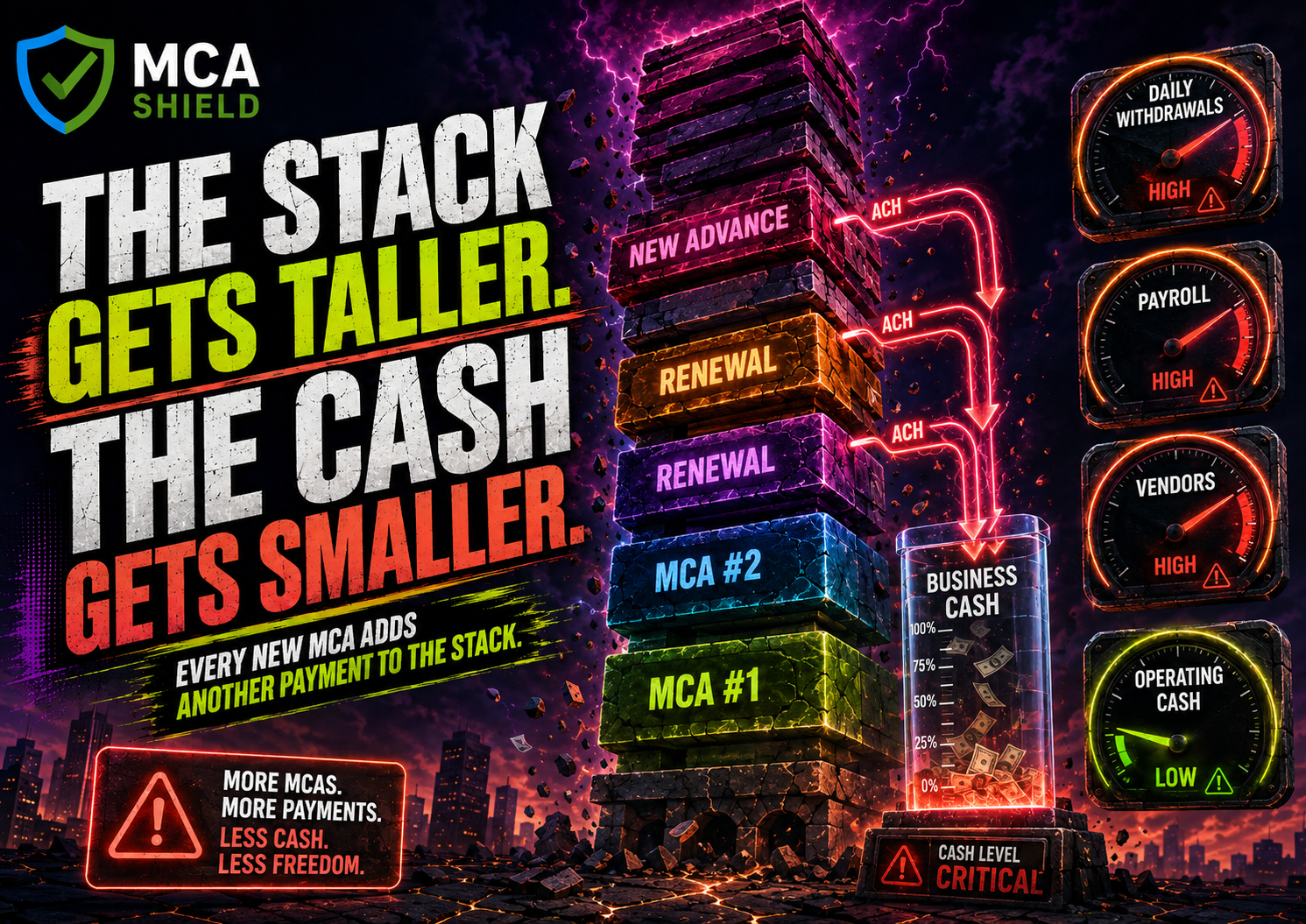
One of the biggest risks of renewing stacked MCAs is the growing pressure on daily cash flow. Each active merchant cash advance may require its own daily or weekly payment. When several advances are stacked together, those withdrawals can take a large portion of the revenue entering the business.
A company may still be making sales and generating income, yet struggle to keep enough money in its account. The issue is not always a lack of revenue. In many cases, the problem is that too much revenue is being committed to MCA payments before the business can use it for operations.
Repeated renewals can make this pressure worse. A new advance may provide temporary cash, but it can also create another payment obligation that must be supported by future revenue.
Multiple ACH Withdrawals Can Consume Operating Cash
Many merchant cash advances are repaid through automatic ACH withdrawals from the business bank account. With one MCA, the withdrawal may be manageable. With several stacked MCAs, multiple payments can be deducted from the account on the same day.
For example, a business could have money withdrawn for three or four different advances before it pays a single employee, vendor, or operating expense. This can quickly reduce the amount of working capital available for day-to-day operations.
As withdrawals increase, the business may begin struggling with:
- Payroll and employee expenses
- Vendor and supplier invoices
- Rent and utility payments
- Inventory and materials
- Taxes and insurance
- Unexpected business expenses
If account balances remain low, the company may also experience overdrafts, returned payments, or difficulty maintaining minimum cash reserves.
This is often when another MCA renewal begins to look attractive. The business needs additional cash because existing withdrawals are consuming too much of its operating revenue.
Higher Payment Obligations Can Make Cash Flow Harder to Manage
Cash flow becomes more difficult to manage when a growing percentage of daily revenue is already committed to MCA payments.
A business may receive $20,000 in revenue during a week, but that does not mean the full $20,000 is available to operate the company. If thousands of dollars are automatically withdrawn for several MCAs, the business must manage payroll, vendors, inventory, and other expenses with whatever remains.
When stacked MCA payments continue increasing, even small changes in revenue can create problems. A slow week, delayed customer payment, equipment repair, or seasonal downturn may leave the business without enough cash to cover its normal obligations.
This can create a dangerous cycle:
Higher MCA payments → less operating cash → greater cash-flow pressure → need for new funding → additional MCA payments
Over time, the business may lose the financial flexibility it once had. Instead of deciding how to use its revenue, a growing portion of that revenue is automatically directed toward existing advances.
If daily MCA payment pressure is making it difficult to maintain normal operations, another renewal may only add to the problem. Reviewing the existing agreements, balances, and cash flow can help determine whether a different strategy may be needed.
Can Repeated MCA Renewals Increase the Total Cost of Your Debt?
Yes. Repeated MCA renewals can increase the total amount your business ultimately pays, especially when new advances are added before previous obligations are fully resolved.
A renewal may appear to solve an immediate cash-flow problem, but it can also introduce new fees, new repayment terms, and a new factor rate. If this happens several times, the cost of financing can continue to build even if the business is regularly making payments.
This is one reason renewing stacked MCAs can become expensive over time. The business may continue receiving new capital, but a growing portion of future revenue may already be committed to repaying previous advances and their associated costs.
New Fees and Factor Rates Can Add to the Amount Owed
Merchant cash advances commonly use a factor rate rather than a traditional interest rate. The factor rate helps determine the total amount the business is expected to repay.
For example, if a business receives a new advance, the repayment amount may be higher than the actual cash received because the factor rate and other costs are built into the agreement.
When a business renews repeatedly, it may take on new financing costs each time. If several MCAs are active, those costs can overlap and place additional pressure on cash flow.
The business may also face:
- New origination or administrative fees
- Additional factor-rate costs
- Higher total repayment obligations
- Multiple daily or weekly withdrawals
- Reduced working capital after payments are deducted
This can make it difficult to understand the true cost of continued MCA borrowing. The business may focus on the amount of new cash it receives without fully considering the total repayment amount created by the renewal.
Why Paying Off an MCA Early Through Renewal May Not Mean You Are Saving Money
A business owner may assume that renewing an MCA early will reduce the cost of the existing advance. That is not always the case.
In some renewals, part of the new advance is used to pay off the remaining balance of the previous MCA. However, the business may then enter a new agreement with its own factor rate, fees, and repayment obligation.
As a result, paying off one MCA through a renewal does not necessarily mean the overall debt burden has been reduced. The business may simply be replacing one obligation with another.
This is especially important when several advances are stacked. A company could pay off one MCA while still making payments on others, then add another new advance to the stack.
Before accepting another renewal, it is important to compare the amount of new cash received, the remaining balance being paid off, the new repayment amount, and the total cost of the new agreement.
Understanding those numbers can help determine whether the renewal is actually improving the company’s financial position or simply extending the MCA debt cycle.
How Stacked MCA Renewals Can Affect Payroll, Vendors, and Working Capital
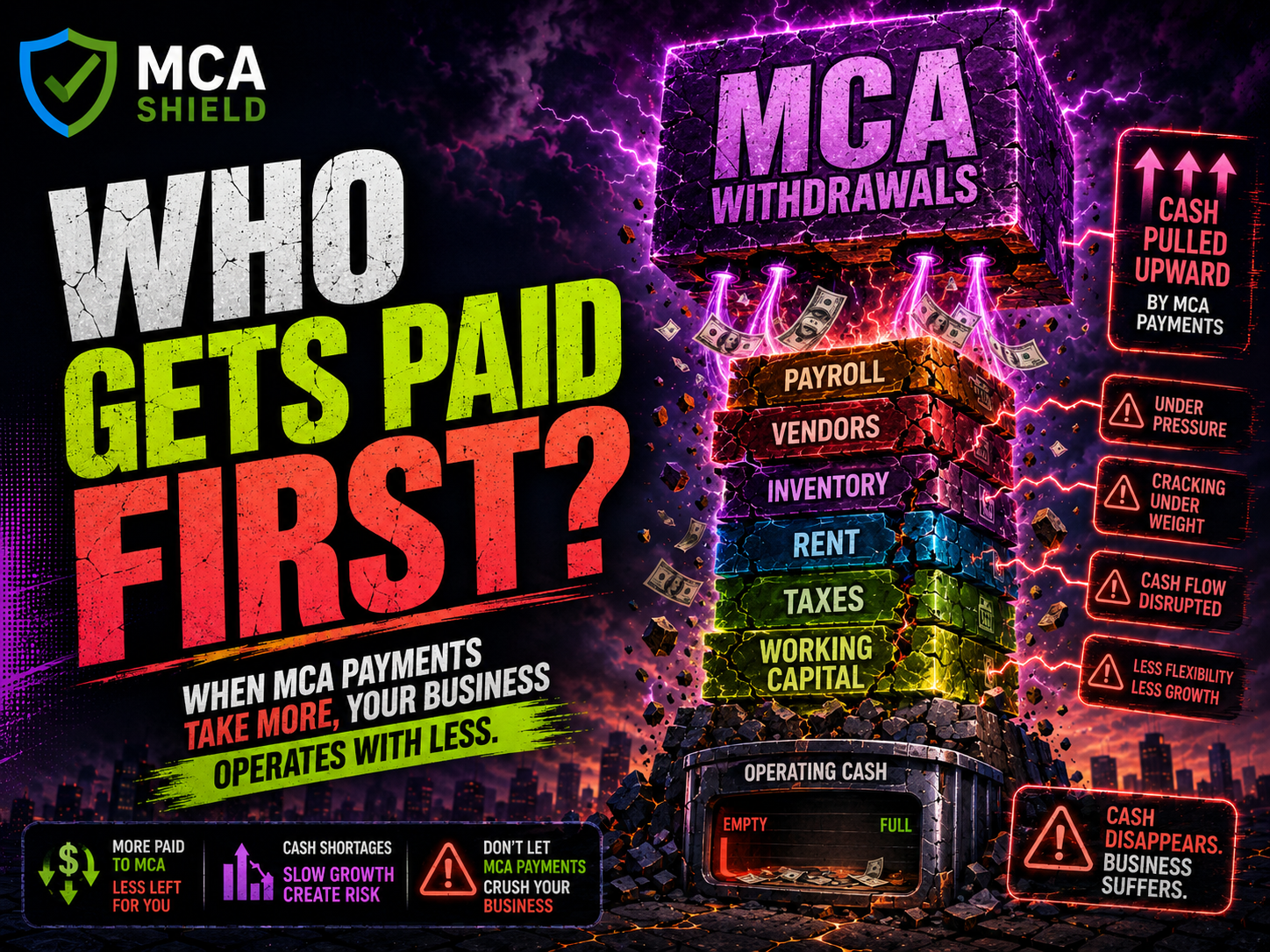
Repeated stacked MCA renewals can affect much more than the business bank account. As daily or weekly withdrawals increase, the company may have less cash available for the expenses that keep the business running.
This can create pressure across several areas at once. Payroll still has to be met. Vendors still expect payment. Inventory, rent, insurance, taxes, and operating costs do not disappear because MCA payments are increasing.
When too much revenue is committed to merchant cash advance payments, the business may begin choosing which obligations get paid first. That can be a sign that working capital is becoming dangerously limited.
When MCA Payments Begin Competing With Essential Business Expenses
A healthy business needs enough operating cash to cover both planned and unexpected expenses. However, stacked MCA withdrawals can begin competing directly with those needs.
For example, the business may have to decide whether available cash should go toward:
- Employee payroll
- Vendor and supplier payments
- Inventory or materials
- Rent and utilities
- Insurance and taxes
- Equipment repairs
- MCA withdrawals
When these obligations begin competing for the same limited cash, financial stress can increase quickly.
Late vendor payments may affect supplier relationships. Delayed inventory purchases may slow production or sales. Payroll pressure can create problems for employees and management. Even small unexpected expenses can become harder to absorb.
At that point, the issue is no longer just the cost of the MCA. It is the effect that stacked MCA payments are having on the entire operation of the business.
Why Shrinking Working Capital Can Create a Financial Tipping Point
Working capital gives a business room to operate. It helps cover expenses between customer payments, seasonal changes, slow weeks, and unexpected costs.
When repeated MCA renewals reduce that cushion, the business becomes more vulnerable.
A company with strong working capital may be able to handle a delayed invoice or an emergency repair without major disruption. A business with very little cash left after MCA withdrawals may not have that same flexibility.
This is where a financial tipping point can occur. The business may still be generating revenue, but there may no longer be enough operating cash available after MCA payments to keep everything current.
Warning signs can include late payroll, past-due vendor invoices, overdrafts, declining account balances, missed tax payments, and repeated requests for new funding.
If the business reaches the point where another renewal is needed simply to cover normal operating expenses, it may be time to reconsider the strategy. Protecting payroll, vendors, cash reserves, and working capital may require reducing payment pressure rather than adding another MCA to the stack.
Can Renewing One MCA Lead to Even More Stacked Advances?
Yes. Renewing one merchant cash advance can sometimes make it easier for a business to take on additional advances later. If the new funding does not solve the underlying cash-flow problem, the company may eventually need another source of capital.
This is how one MCA renewal can turn into several stacked advances. The business receives new funding, uses some of it to manage current obligations, and then faces another cash shortage after daily or weekly withdrawals continue.
Over time, the company may begin relying on MCA funding more often. Instead of using advances for a specific growth opportunity, the business may start using them simply to maintain normal operations.
How Businesses Can Become Dependent on New MCA Funding
Merchant cash advances can provide quick access to capital, which is one reason businesses may return to them when cash is tight. The problem begins when new MCA funding becomes necessary to keep the business operating.
A company may use new advances to cover:
- Payroll
- Vendor invoices
- Inventory or materials
- Rent and utilities
- Existing MCA withdrawals
- Unexpected operating expenses
Each new advance may provide temporary relief. However, it can also create another repayment obligation that reduces future cash flow.
If this pattern continues, the business can become dependent on repeated renewals. Cash shortages lead to new funding, new funding creates more payments, and those payments create another cash shortage.
That cycle can look like this:
Cash-flow shortage → new MCA → higher withdrawals → less working capital → another cash-flow shortage
The longer this continues, the more difficult it may become to break the cycle.
The Danger of Borrowing to Make Existing MCA Payments
One of the clearest warning signs is when a business begins borrowing money to make payments on existing MCAs.
At that point, new financing is no longer supporting growth. It is being used to manage previous financing.
For example, a business may take a new advance because several ACH withdrawals are scheduled and there is not enough cash in the account. The new MCA helps cover those payments, but it also adds another daily or weekly withdrawal.
This can increase the total payment burden and leave even less money available for normal operations.
The result can be a growing stack of obligations where future revenue is being used to pay for past advances. That can make payroll, vendor payments, taxes, and other essential expenses harder to manage.
If a business is repeatedly taking new advances to cover older ones, it may be time to review the full MCA structure. MCA restructuring or consolidation may offer a more organized way to address payment pressure without continuing to add new advances.
What Are the Warning Signs That MCA Renewals Are Becoming Unsustainable?
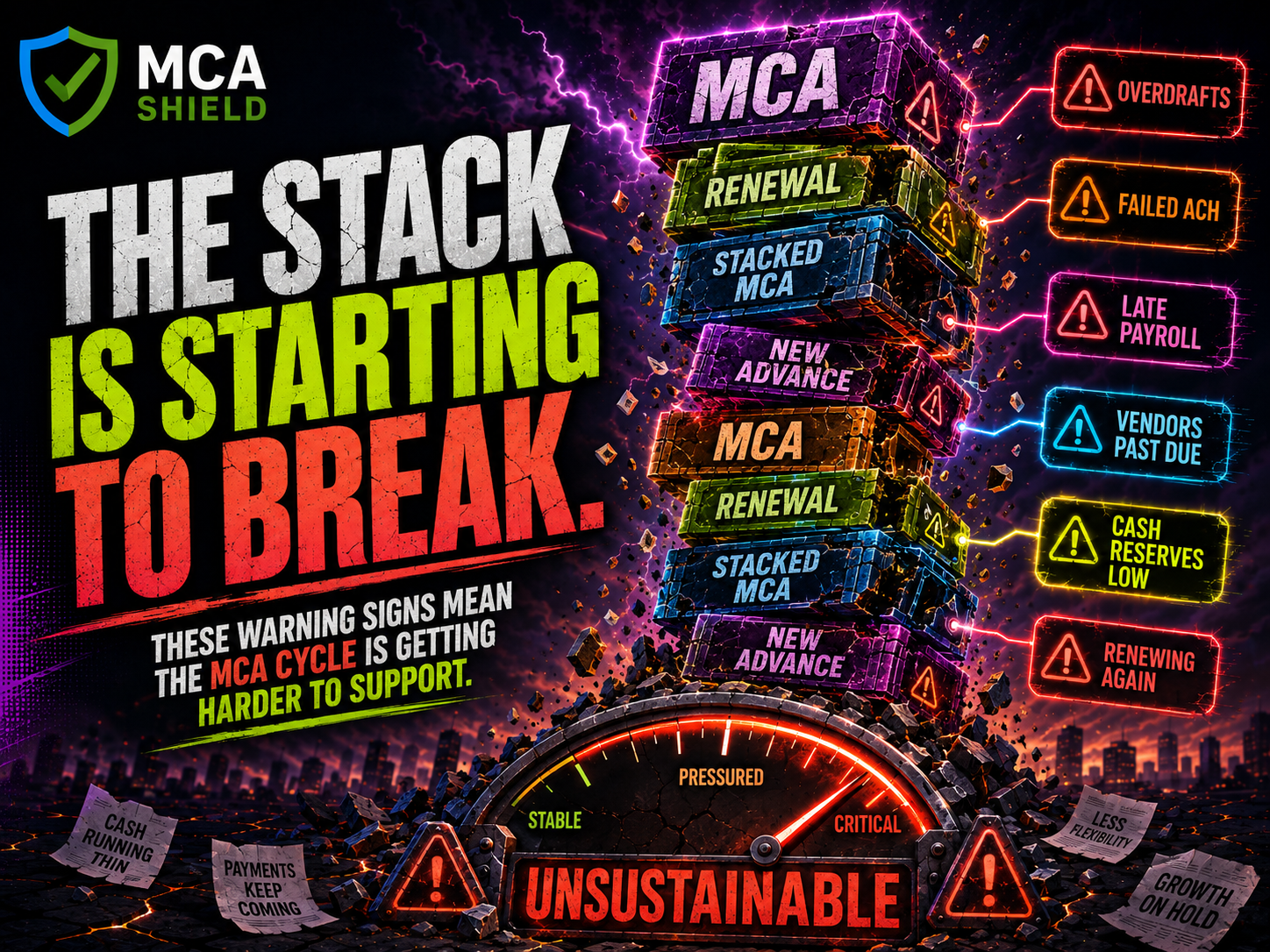
Repeated renewals may become unsustainable when a business can no longer keep up with MCA payments and normal operating expenses at the same time. The warning signs often appear gradually, but they should not be ignored.
A company may still be generating revenue while its available cash continues to shrink. If more money is leaving the account through daily or weekly withdrawals, the business can become increasingly dependent on new funding.
Recognizing these warning signs early can help a business owner decide whether renewing stacked MCAs is making the financial situation worse.
Increasing Overdrafts, Missed Payments, and Cash Shortages
Frequent overdrafts are one of the clearest signs that MCA payment pressure is becoming difficult to manage.
If several ACH withdrawals are hitting the business account each day, there may not be enough cash left to cover other expenses. The company may begin experiencing returned payments, overdraft fees, missed withdrawals, or consistently low bank balances.
Cash shortages may also become more frequent. A business that once had enough money to cover several weeks of expenses may begin struggling to make it through a few days without additional funding.
Other warning signs include:
- Failed or returned ACH withdrawals
- Increasing bank overdrafts
- Missed vendor payments
- Late payroll
- Declining cash reserves
- Difficulty maintaining a positive account balance
When these problems become routine instead of occasional, the current MCA structure may no longer fit the business’s cash flow.
Renewing Earlier or More Frequently Than Before
Another warning sign is the need to renew MCAs sooner than expected.
A business may initially take an advance and make payments for several months before considering another funding option. As payment pressure increases, however, the time between advances may become shorter.
If the company begins renewing earlier or taking new MCAs more frequently, it may indicate that the existing advances are consuming too much working capital.
For example, a business that once needed additional funding twice a year may begin seeking new advances every few months. Eventually, the company may start looking for another MCA almost immediately after receiving the previous one.
This pattern can create a growing dependence on new funding and make the stacked MCA cycle harder to break.
Struggling to Cover Normal Operating Expenses
A business should be able to use its revenue to support normal operations. When MCA payments begin preventing that, the situation deserves attention.
The company may struggle to cover payroll, rent, utilities, inventory, materials, insurance, taxes, and vendor invoices. Management may begin delaying expenses or moving money between accounts just to make it through the week.
Another warning sign is using credit cards, loans, or new MCAs to cover routine expenses that were previously paid from operating revenue.
At that point, the problem may no longer be a temporary cash shortage. It may be a sign that stacked MCA payments are consuming more cash than the business can reasonably support.
When several of these warning signs appear together, another renewal may only increase the pressure. Reviewing current balances, payment schedules, agreements, and available cash flow can help determine whether MCA restructuring or consolidation may be a more sustainable option.
What Can Happen If Your Business Can No Longer Keep Up With Stacked MCA Payments?
When a business can no longer keep up with stacked MCA payments, the financial pressure can escalate quickly. Missed withdrawals may lead to collection efforts, additional fees, default claims, or other actions permitted under the MCA agreements.
The exact consequences depend on the contract terms, payment history, funder, and applicable law. However, ignoring the problem can make it harder to regain control of cash flow.
If your business is already struggling to cover multiple daily or weekly payments, it is important to understand what may happen next and review your options before the situation becomes more serious.
Failed ACH Withdrawals, Defaults, and Collection Activity
Many merchant cash advance payments are collected through automatic ACH withdrawals from the business bank account. If there is not enough money available, a withdrawal may fail or be returned.
One missed payment may not always create an immediate crisis. However, repeated failed withdrawals can signal that the current payment structure is no longer sustainable.
Depending on the agreement, the business may face:
- Returned ACH payments
- Default notices
- Additional fees or charges
- Collection calls or written demands
- Requests for updated financial information
- Attempts to enforce contractual remedies
Collection activity can add even more pressure when the business is already dealing with payroll, vendors, taxes, and other expenses.
This is why waiting until several payments have failed can be risky. The earlier the business reviews its MCA balances, agreements, payment schedules, and available cash flow, the more time it may have to consider possible solutions.
UCC Filings, Personal Guarantees, and Potential Legal Pressure
Some merchant cash advance agreements may include UCC-related provisions, personal guarantees, or other protections for the funder. These provisions can become especially important if the business falls behind or a dispute develops.
A UCC filing may give notice of a funder’s claimed security interest in certain business assets, depending on the agreement and applicable law. Multiple MCA relationships can make these filings more complicated, especially when several funders claim interests connected to the same business.
A personal guarantee may also create additional exposure for the business owner if specific obligations under the agreement are triggered. The scope and enforceability of a guarantee depend on the actual contract and applicable law.
If payment problems continue, a funder may also pursue collections, arbitration, litigation, or other contractual remedies. Not every missed payment leads to a lawsuit, but legal pressure can become more serious when the business stops communicating or the dispute remains unresolved.
For that reason, businesses struggling with stacked MCAs should carefully review UCC filings, personal guarantees, default provisions, and other legal terms before making major decisions.
If the payment burden is no longer manageable, addressing the problem early may provide more options than continuing to renew advances until the business reaches default. MCA restructuring, consolidation, or professional legal guidance may be worth considering depending on the specific situation.
When Should You Consider MCA Restructuring or Consolidation Instead of Another Renewal?
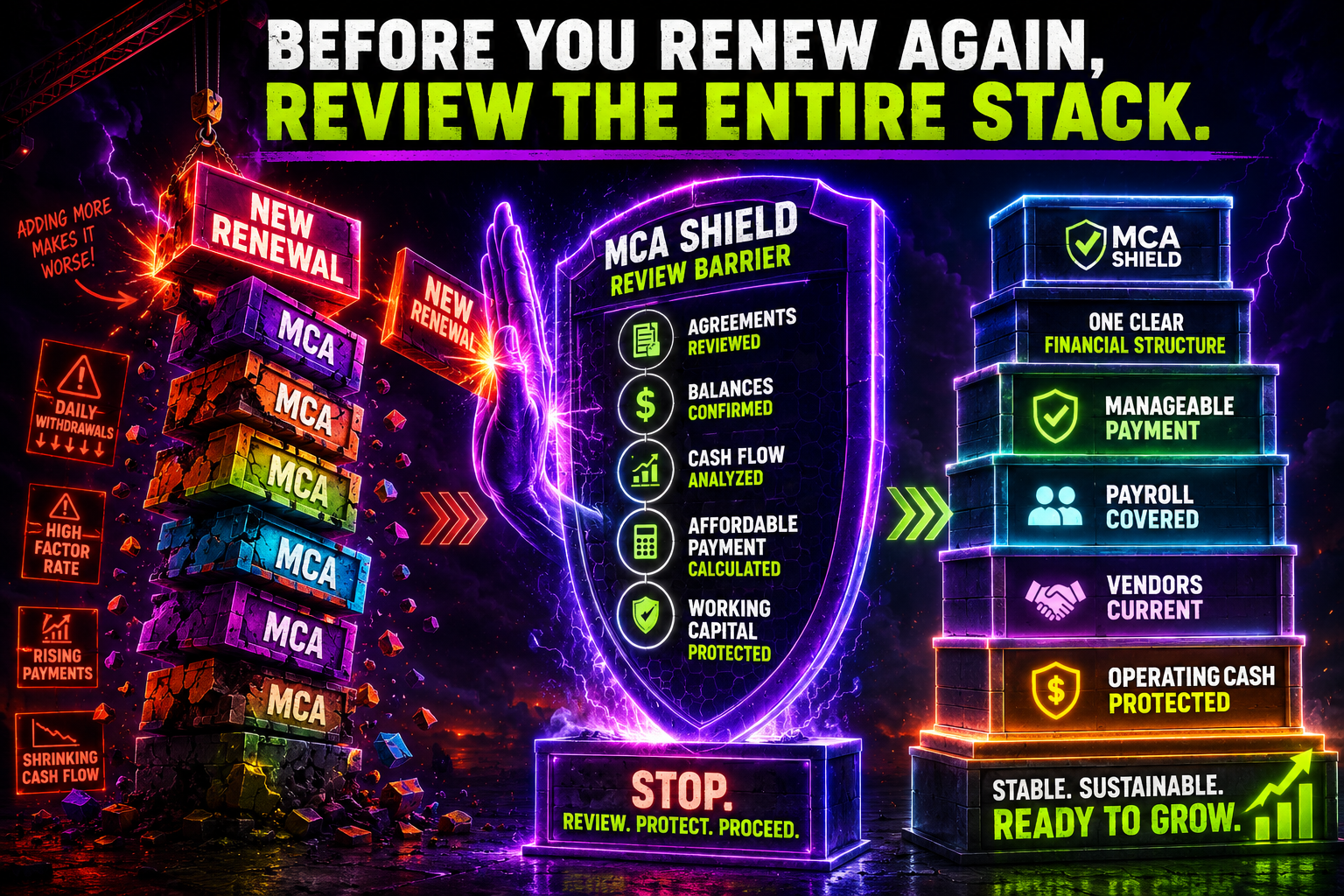
If your business is already carrying several merchant cash advances, taking another renewal may not solve the real problem. It may provide short-term cash, but it can also increase the amount of revenue committed to future payments.
This is often the point when MCA restructuring or consolidation should be considered. Instead of adding another advance, the goal is to evaluate the existing obligations and determine whether the payment structure can be made more manageable.
If your company is constantly short on cash, struggling with multiple withdrawals, or using new funding to cover old MCA payments, another renewal may only continue the cycle.
Reviewing Agreements, Balances, and Current Cash Flow
The first step is to understand exactly where the business stands.
Review every active MCA agreement and identify the remaining balance, payment amount, withdrawal schedule, renewal terms, fees, and any default provisions. When several advances are active, it is important to look at the entire stack together.
Then compare those obligations with the company’s actual cash flow.
Ask questions such as:
- How much revenue is coming in each week?
- How much is being withdrawn for MCA payments?
- How much cash remains after payroll and operating expenses?
- Are bank balances steadily declining?
- Is new financing being used to cover existing obligations?
This review can help reveal whether the current MCA payments are still sustainable or whether they are consuming too much of the business’s operating cash.
Calculating a Payment the Business Can Realistically Afford
A payment plan only works if the business can actually afford it.
That means looking beyond the MCA balances and considering the full cost of running the company. Payroll, rent, vendors, inventory, taxes, insurance, utilities, and other essential expenses must still be covered.
A realistic payment should leave enough cash in the business to continue operating.
If MCA withdrawals are consuming so much revenue that normal expenses are being delayed, the current payment structure may be too aggressive.
The objective of restructuring or consolidation is to work toward a payment amount that better fits the company’s current cash flow, rather than continuing to add new advances.
Protecting Working Capital Instead of Adding Another Advance
Working capital is what keeps the business moving from one day to the next. It pays employees, covers vendors, replaces inventory, handles repairs, and provides a cushion when revenue slows.
Repeatedly renewing stacked MCAs can reduce that cushion.
Another advance may increase the cash available today, but the additional payment obligation can reduce the cash available in the weeks and months ahead.
For many businesses, the better long-term goal is to protect working capital and reduce payment pressure.
MCA restructuring or consolidation may help organize multiple obligations into a more manageable strategy. Depending on the situation, this can make it easier to understand what is owed, what the business can afford, and how much cash needs to remain available for operations.
If another renewal would simply create more debt, more withdrawals, and less working capital, it may be time to consider a different approach.
How Can You Break the Cycle of Renewing Stacked MCAs?
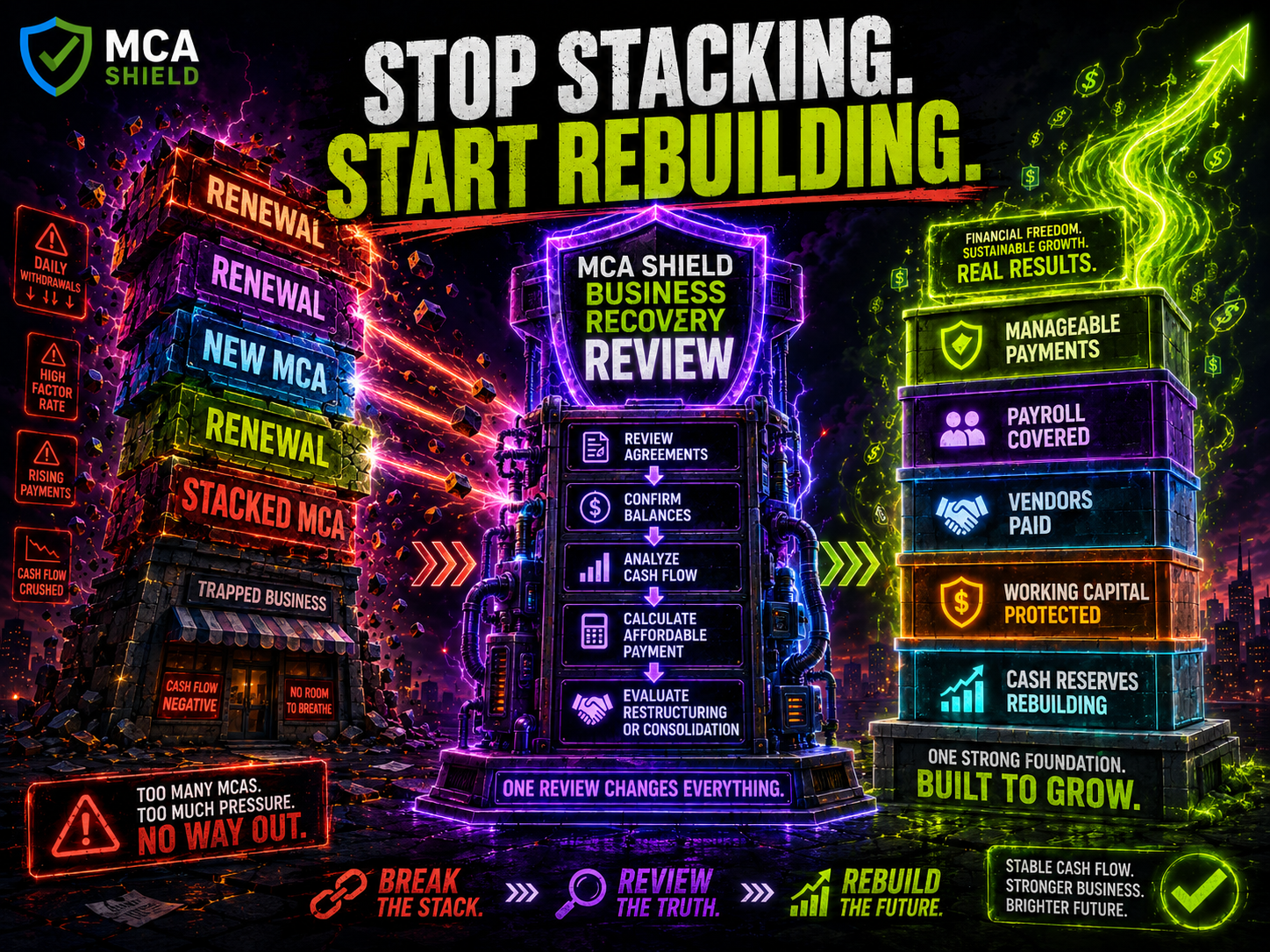
Breaking the cycle of renewing stacked MCAs starts with recognizing that another advance may not solve the underlying problem. If new funding is mainly being used to cover existing MCA payments or normal operating expenses, the business may need a different strategy.
The goal is to reduce financial pressure before it becomes even harder to manage. That means reviewing the current obligations, understanding the true cash-flow impact, and creating a plan that protects the business’s ability to operate.
Instead of continuing to add new advances, business owners should focus on reducing payment pressure, preserving working capital, and improving cash-flow stability.
Create a Clear Plan Before Cash-Flow Pressure Gets Worse
The earlier a business reviews its MCA obligations, the more time it may have to consider available options.
Start by gathering all active MCA agreements and identifying the remaining balances, payment amounts, withdrawal schedules, fees, and renewal terms. Then compare those payments with the company’s actual revenue and operating expenses.
A clear plan should answer several important questions:
- How much is the business currently paying toward MCAs?
- How much cash is needed for payroll and operations?
- Which advances are creating the most payment pressure?
- Can the business continue making the current payments?
- Would restructuring or consolidation create a more manageable payment structure?
This process can help the business move away from reacting to each cash shortage with another renewal.
The objective is to create a strategy that supports manageable payments, protected working capital, and stronger cash flow.
Schedule a Free Consultation With MCA Shield
If your business is struggling with stacked MCA payments, repeated renewals, or shrinking working capital, MCA Shield can help you review your current situation.
The process can include reviewing your agreements, confirming balances, analyzing cash flow, and determining what level of payment the business may realistically be able to support.
From there, MCA Shield can help evaluate whether MCA restructuring or consolidation may be appropriate based on your specific circumstances.
You do not have to wait until payments begin failing or the business reaches a financial crisis. Taking action earlier may give you more time to understand your options and develop a more sustainable plan.
Schedule a free consultation with MCA Shield today to review your stacked MCAs, understand your current payment pressure, and explore possible ways to protect your business’s cash flow.