
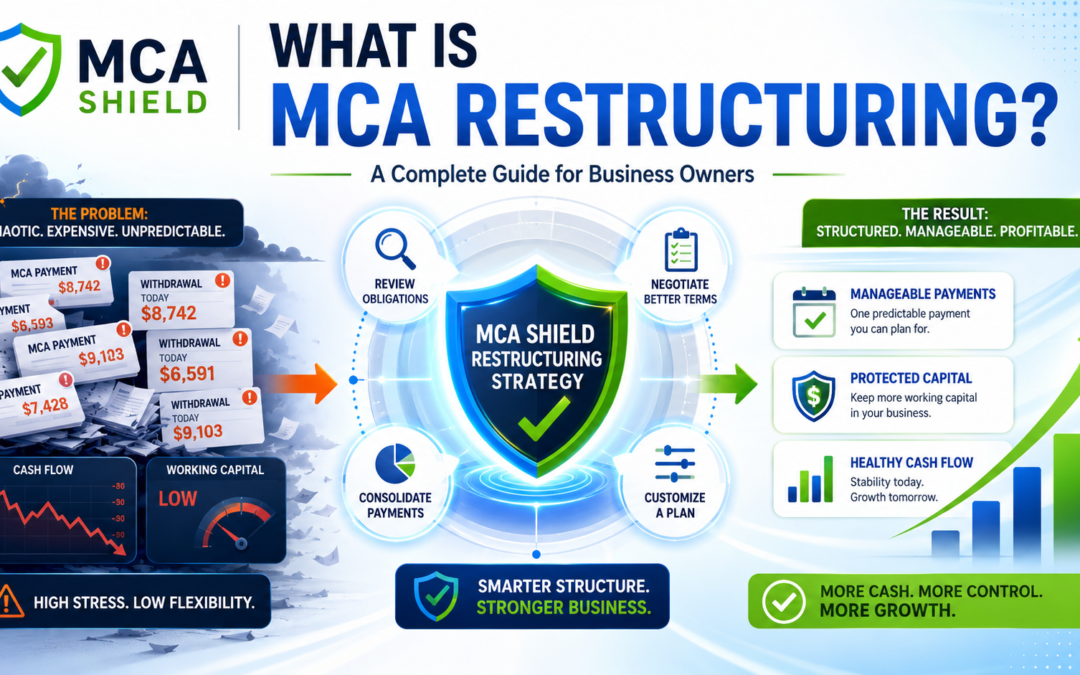
MCA restructuring can help business owners regain control when merchant cash advance payments begin putting too much pressure on daily cash flow. High daily or weekly withdrawals can quickly make it harder to cover payroll, operating expenses, inventory, and other essential business costs.
Instead of simply adding another advance, MCA restructuring focuses on reviewing existing obligations and finding a more manageable payment structure. The goal is to reduce immediate payment pressure while protecting the working capital your business needs to continue operating.
However, every business has a different financial situation. In this guide, we will explain what MCA restructuring is, how the process works, when it may make sense, and how it compares with MCA consolidation and settlement. You will also learn what steps to take if your current MCA payments are becoming difficult to manage.
Schedule Your Free Consultation
What Is MCA Restructuring and How Does It Work?
MCA restructuring is the process of reviewing existing merchant cash advance obligations and working toward a payment structure that better fits a business’s current cash flow. For businesses facing heavy daily or weekly withdrawals, restructuring may provide a way to reduce financial pressure without immediately taking on another advance.
The process usually begins with a complete review of the business’s MCA agreements, payment amounts, remaining balances, and available cash flow. From there, the goal is to determine what the business can realistically afford while continuing to cover essential expenses.
Depending on the situation, MCA restructuring may involve discussions with one or more funders about changing the way payments are handled. The exact options will depend on the agreements, the business’s financial condition, and the willingness of the funders to modify existing terms.
The Goal of Restructuring Merchant Cash Advance Debt
The main goal of restructuring merchant cash advance obligations is to create a more sustainable payment arrangement. When MCA withdrawals consume too much available cash, even a profitable business can struggle to keep enough money on hand for normal operations.
A restructuring strategy should look beyond the MCA payment itself. It should also consider the money the business needs for:
- Payroll
- Rent and utilities
- Inventory and supplies
- Taxes
- Vendor payments
- Working capital
By reviewing these expenses together, a business can identify an affordable payment level that leaves enough cash available to continue operating.
For businesses with multiple advances, this becomes even more important. Several separate MCA withdrawals can create a combined payment burden that is difficult to manage. A coordinated MCA restructuring strategy looks at the full financial picture rather than treating each payment as an isolated problem.
What Can Change During an MCA Restructuring?
An MCA restructuring does not automatically erase an obligation. Instead, the focus is typically on changing the payment structure or repayment terms so they are more manageable for the business.
Depending on the circumstances, restructuring discussions may address factors such as payment frequency, payment amount, repayment schedule, or the way multiple MCA obligations are handled together.
For example, a business struggling with large daily withdrawals may seek a structure that reduces the amount leaving its bank account each day. That additional breathing room can help protect working capital and essential operating expenses.
However, restructuring options vary by funder and agreement. There is no single solution that works for every business. That is why a careful review of the numbers should come first. The objective is to find a structure that addresses the MCA obligations while giving the business a realistic opportunity to stabilize cash flow and continue operating.
Why Businesses Consider MCA Restructuring
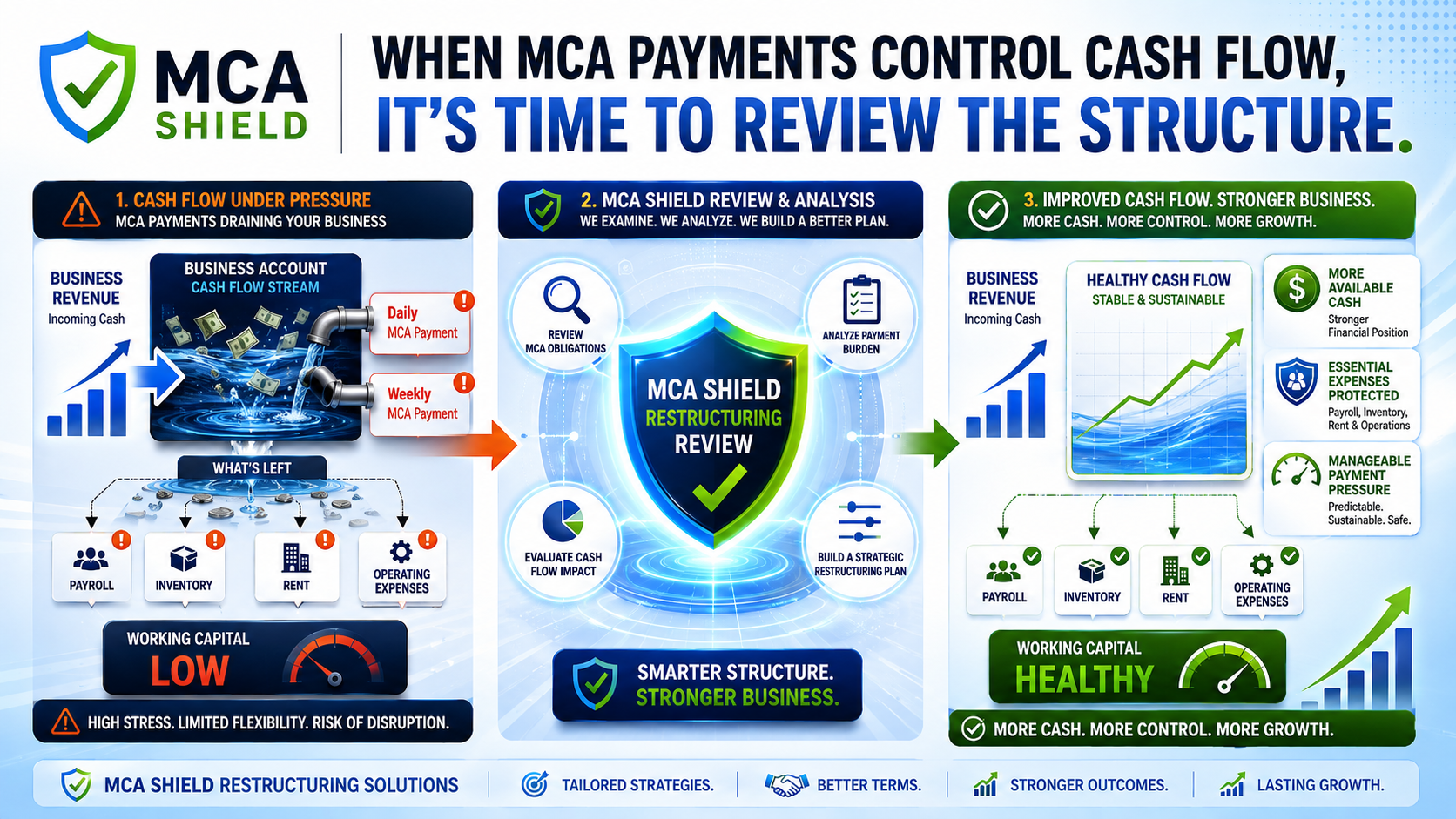
Businesses often turn to MCA restructuring when merchant cash advance payments begin interfering with normal operations. At first, daily or weekly withdrawals may seem manageable. However, as revenue changes or expenses increase, those payments can start consuming too much of the cash the business needs to function.
The problem can become even more serious when a business has multiple MCA agreements. Each payment may look manageable on its own, but together they can place significant pressure on working capital. MCA restructuring can help business owners evaluate the total payment burden and determine whether a more sustainable structure may be possible.
Daily or Weekly Payments Are Draining Cash Flow
Merchant cash advances are often repaid through daily or weekly withdrawals. When those withdrawals take too much money from the business account, cash flow can quickly become strained.
A company may still be generating strong sales while struggling to keep enough available cash for everyday expenses. This happens because a large portion of incoming revenue may be leaving the account almost immediately.
Signs that MCA payments are draining cash flow can include:
- Frequently low bank balances
- Difficulty maintaining adequate working capital
- Delayed vendor payments
- Trouble covering payroll on time
- Using new financing to cover normal operating expenses
When this pattern continues, the business may become increasingly dependent on short-term funding. MCA restructuring may help reduce payment pressure and create more room in the company’s cash flow.
Multiple MCA Payments Are Becoming Difficult to Manage
Managing one merchant cash advance can be challenging. Managing several at the same time can become much more difficult.
With multiple MCA payments, a business may have several withdrawals hitting the same bank account throughout the week. The combined amount can consume a significant percentage of available revenue before the business has a chance to use that money for operations.
This situation is sometimes called MCA stacking. As additional advances are added, business owners may find themselves constantly moving money between obligations just to keep up.
A restructuring review can look at the total MCA payment burden, rather than focusing on one agreement at a time. This provides a clearer picture of how much cash is leaving the business and what payment level may be more realistic.
The goal is not simply to move payments around. The goal is to create a manageable financial structure that gives the business a better chance to stabilize.
Essential Business Expenses Are Being Put at Risk
One of the clearest signs that MCA payments have become unsustainable is when they begin competing with essential business expenses.
A business should not have to constantly choose between making an MCA payment and covering payroll, rent, inventory, taxes, utilities, or vendor obligations. When those basic expenses are being delayed or sacrificed, the payment structure may no longer match the business’s financial reality.
For example, a company may have enough revenue to remain profitable but not enough available cash after daily MCA withdrawals to purchase inventory or pay employees. Over time, that pressure can disrupt operations and make recovery more difficult.
Restructuring merchant cash advance debt can help create additional breathing room by addressing the payment burden before the business reaches a more serious financial crisis.
The earlier a business recognizes these warning signs, the more opportunity it may have to review its options and protect the cash flow needed to keep the business operating.
What Happens During the MCA Restructuring Process?
The MCA restructuring process usually begins with a close look at the business’s current financial situation. Before any changes can be considered, it is important to understand how much the company owes, how often payments are withdrawn, and how those payments affect daily cash flow.
A successful restructuring strategy should focus on more than lowering a payment. It should create a structure that allows the business to meet its MCA obligations while still having enough cash available for payroll, operating expenses, inventory, and other essential costs.
Although every situation is different, the process generally includes reviewing existing agreements, determining what the business can realistically afford, and working toward revised payment terms.
Reviewing Your Current MCA Agreements
The first step is to gather and review every active merchant cash advance agreement. This is especially important for businesses with multiple MCAs because each agreement may have different payment terms, balances, and withdrawal schedules.
A complete review should include:
- Current MCA balances
- Daily or weekly payment amounts
- Payment frequency
- Remaining repayment obligations
- Existing contract terms
- Recent business bank activity
- Any missed or returned payments
Looking at these details together helps show the true impact of MCA payments on business cash flow.
For example, one daily payment may appear manageable by itself. However, three or four separate withdrawals could leave very little cash available after revenue enters the account. Reviewing all obligations together provides a clearer picture of the financial pressure facing the business.
Determining an Affordable Payment Structure
Once the current obligations are understood, the next step is determining what the business can realistically afford.
This calculation should not be based only on revenue. A business may generate significant sales and still struggle with cash flow if too much money is leaving the account each day.
Instead, an affordable payment structure should consider both revenue and essential expenses. These may include payroll, rent, utilities, taxes, inventory, insurance, vendor costs, and working capital needs.
The goal is to identify a payment level that allows the business to continue meeting its obligations without constantly running short of cash.
This is one of the most important parts of MCA restructuring. A payment arrangement that still leaves the business unable to cover basic expenses may only delay the underlying problem.
Working Toward Revised Payment Terms
After the financial review is complete, the next stage involves working toward revised MCA payment terms that better reflect the business’s current ability to pay.
Depending on the agreement and the funder, discussions may involve changes to the payment amount, payment frequency, repayment schedule, or overall payment structure. For businesses with several MCAs, the strategy may also involve coordinating multiple obligations rather than addressing each one separately.
Any proposed terms should be reviewed carefully before the business agrees to them. The goal should be a structure that provides meaningful relief while remaining realistic over the long term.
When handled properly, MCA restructuring can create a more manageable payment structure, reduce pressure on working capital, and give the business more room to operate. The strongest restructuring strategy is one that addresses the current payment problem while also helping the business move toward more stable cash flow.
MCA Restructuring vs. MCA Consolidation
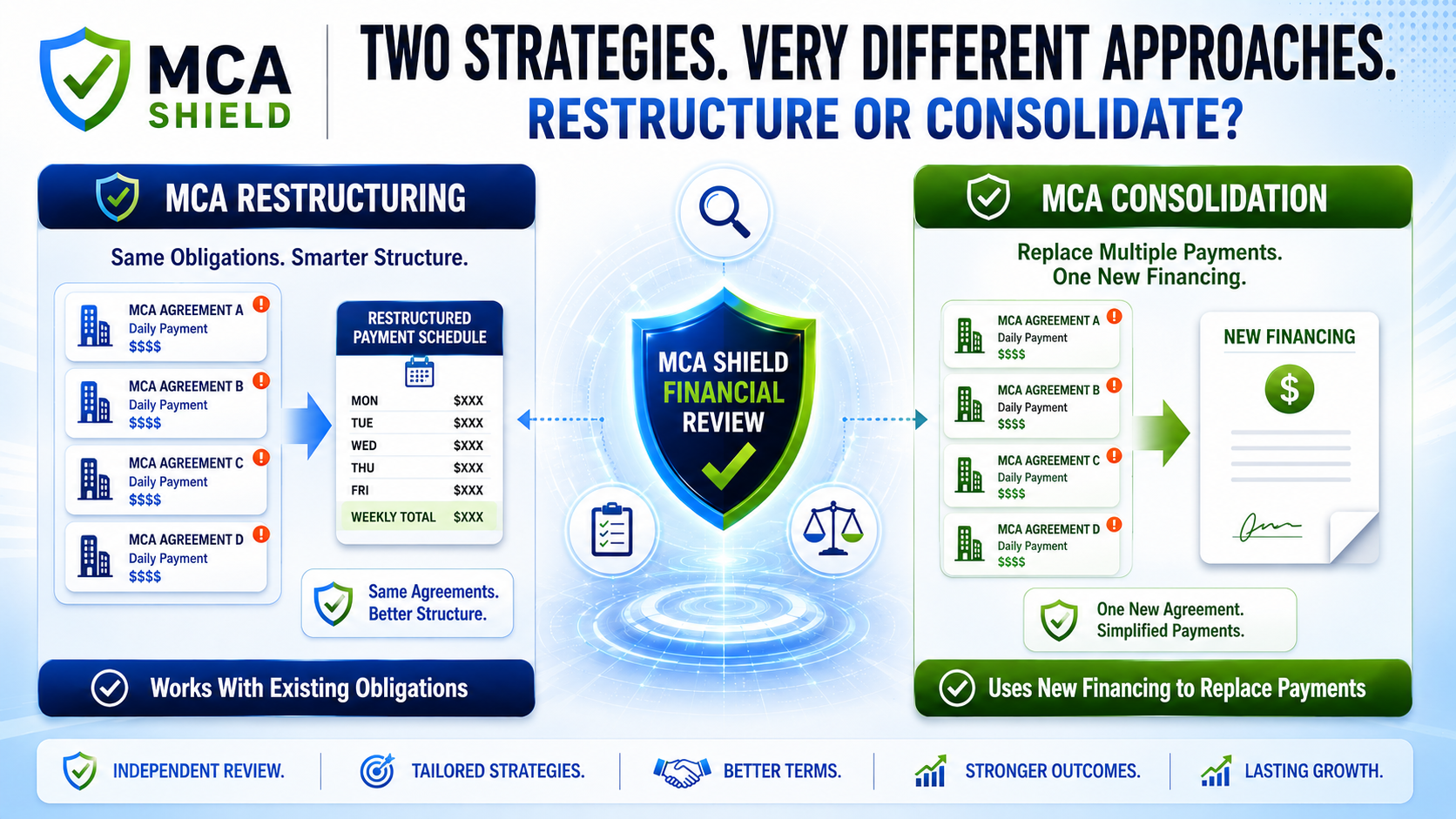
MCA restructuring and MCA consolidation are sometimes discussed as if they are the same solution. However, they can involve very different approaches to reducing merchant cash advance payment pressure.
In simple terms, MCA restructuring focuses on changing the terms or payment structure of existing obligations. MCA consolidation, on the other hand, may involve replacing several existing payments with a new financing arrangement.
Both strategies may be designed to improve cash flow. However, the right option depends on the business’s current obligations, available financing, revenue, and ability to maintain future payments.
Restructuring Existing Obligations
With MCA restructuring, the focus remains on the merchant cash advance obligations the business already has. Instead of taking out another advance, the goal is to determine whether the existing payment structure can be modified.
Depending on the circumstances, restructuring may involve changes to:
- Daily or weekly payment amounts
- Payment frequency
- Repayment schedules
- Terms involving multiple MCA obligations
- The overall amount of cash leaving the business each week
This approach can be especially important when a business already has several advances and does not want to add another layer of debt or payment pressure.
For example, a company may have enough revenue to remain operational but struggle because several MCA withdrawals are hitting the account every day. A restructuring strategy would focus on those existing obligations and look for a more manageable payment structure.
The objective is to protect working capital and business cash flow while addressing the MCA obligations already in place.
Consolidating MCA Payments Into New Financing
MCA consolidation generally involves replacing multiple merchant cash advance payments with a new financing arrangement. Ideally, the new structure creates fewer payments and lowers the amount of cash leaving the business on a regular basis.
For some businesses, that can simplify cash flow management. Instead of several MCA withdrawals, the company may have one new payment to manage.
However, consolidation should be reviewed carefully. A lower payment does not automatically mean the financing is better.
Business owners should consider factors such as:
- The total cost of the new financing
- The length of the repayment period
- Fees and additional financing costs
- Whether existing MCA obligations will be fully satisfied
- The amount of the new daily, weekly, or monthly payment
- Whether the business will have enough working capital after consolidation
In some cases, taking on new financing simply moves the problem rather than solving it. If the new payment is still too high, the business may continue struggling with cash flow.
That is why the key difference matters. MCA restructuring works with existing obligations, while consolidation generally introduces a new financing structure to replace or combine them.
Before choosing either option, business owners should review the full financial impact. The best strategy is the one that creates sustainable payments, protects essential operating cash, and reduces the risk of needing another MCA later.
MCA Restructuring vs. MCA Settlement
MCA restructuring and MCA settlement are two different strategies for dealing with merchant cash advance debt. Both may be used when current payments have become difficult to manage, but they are designed for different financial situations.
In general, MCA restructuring focuses on changing the payment structure of an existing obligation so the business can continue making payments under more manageable terms. MCA settlement usually involves trying to resolve the obligation for an agreed amount, often when the current payment arrangement is no longer sustainable.
Understanding the difference is important because the wrong strategy can create additional financial pressure.
When Restructuring May Be the Better Strategy
MCA restructuring may be the better option when the business can still afford to make payments, but the current daily or weekly withdrawals are too aggressive for its cash flow.
For example, a business may still have steady revenue and a viable operation. However, large MCA withdrawals may leave too little cash available for payroll, inventory, rent, taxes, and other essential expenses.
In that situation, restructuring may focus on creating a more manageable payment arrangement rather than trying to eliminate the obligation.
Restructuring may make sense when:
- The business is still generating consistent revenue
- Current MCA payments are creating cash-flow pressure
- A lower or revised payment could be sustainable
- The business wants to avoid taking on another advance
- There is enough income to support a realistic repayment plan
The objective is to reduce immediate pressure while allowing the business to continue operating.
A strong MCA restructuring strategy should also look at long-term affordability. Lowering a payment is only helpful if the business can maintain the new structure without falling behind on other obligations.
When Settlement May Need to Be Considered
MCA settlement may become a consideration when the business can no longer support the existing payment structure, even after reviewing possible restructuring options.
This can happen when revenue has fallen significantly, multiple MCA obligations have created severe payment pressure, or the business has already fallen behind.
Settlement generally focuses on reaching an agreement to resolve the obligation for an agreed amount or under different payoff terms. However, settlement outcomes are not guaranteed, and every funder may handle the process differently.
A business may begin evaluating settlement when:
- Current payments are no longer sustainable
- Cash flow has deteriorated significantly
- Multiple MCAs are competing for limited available cash
- The business has missed or returned payments
- A realistic restructuring arrangement cannot be reached
Before choosing settlement, business owners should understand the potential financial, contractual, tax, and legal consequences. The terms of each MCA agreement can also affect the available options.
Ultimately, the choice between MCA restructuring and MCA settlement depends on the financial condition of the business. If the company can continue making payments under a more affordable structure, restructuring may be the better path. If the obligation has become impossible to maintain, settlement may need to be evaluated as part of a broader debt-relief strategy.
Can You Restructure Multiple Merchant Cash Advances at the Same Time?
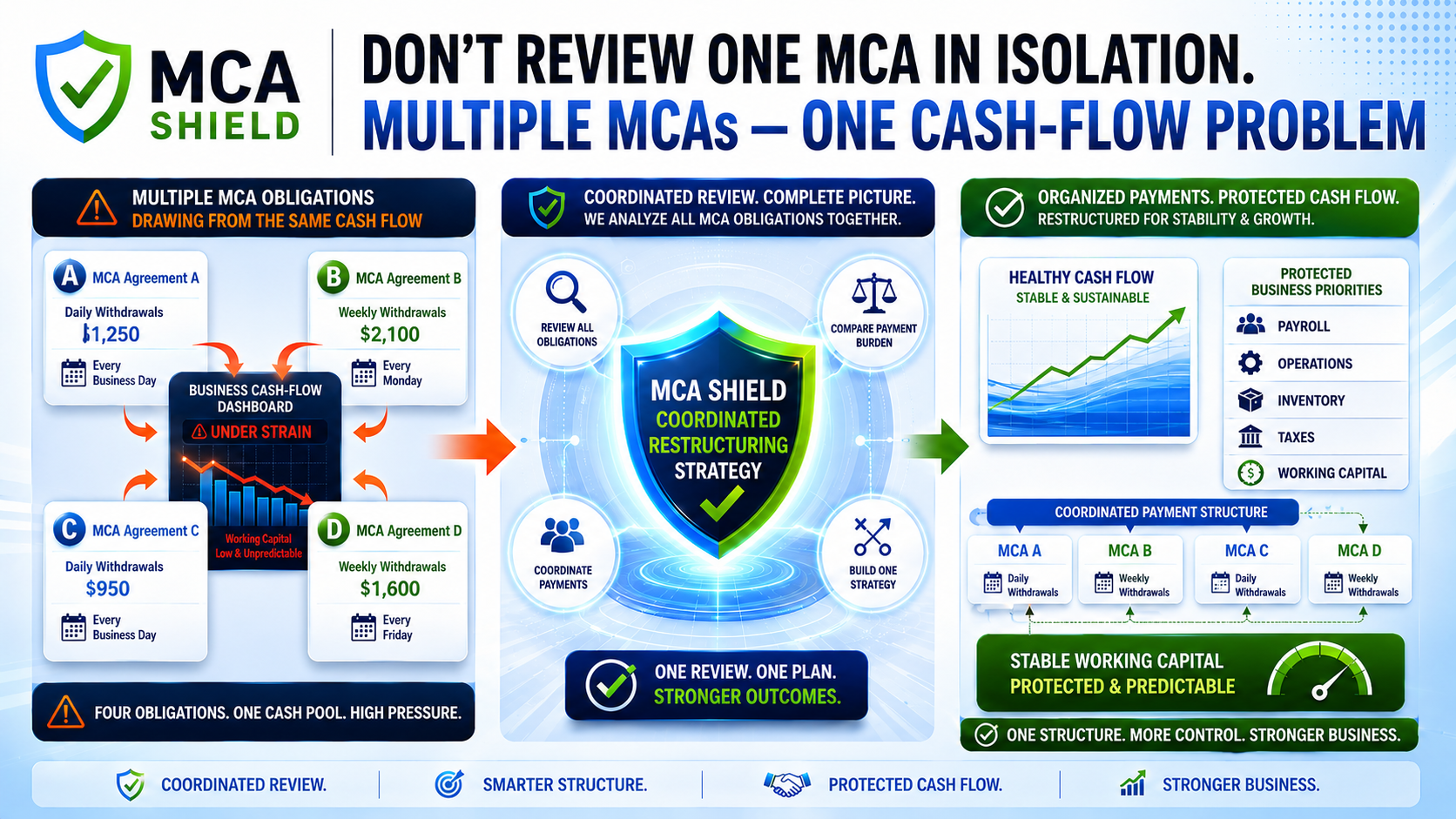
Yes, businesses with several merchant cash advances may be able to pursue MCA restructuring across multiple obligations. However, the process can be more complex than restructuring a single advance.
Each MCA may have a different funder, payment amount, withdrawal schedule, and remaining balance. Because all of those payments affect the same business cash flow, they should not always be viewed as separate problems.
Instead, an effective strategy begins by looking at the total MCA payment burden. This makes it easier to understand how much money is leaving the business and what payment structure may be sustainable.
Looking at the Total MCA Payment Burden
When a business has multiple MCAs, focusing on only one payment can provide an incomplete picture.
For example, reducing one daily withdrawal may offer some relief. However, the business could still struggle if several other MCA payments continue draining the same bank account.
A complete review should consider:
- Every active MCA agreement
- Current balances
- Daily or weekly withdrawal amounts
- Payment schedules
- Total weekly MCA payments
- Monthly business revenue
- Essential operating expenses
- Available working capital
These numbers help show how much of the company’s revenue is being consumed by merchant cash advance payments.
The goal is to determine what the business can realistically afford across all of its obligations while still maintaining enough cash for normal operations.
This broader approach can be especially valuable for businesses dealing with stacked merchant cash advances. Instead of solving one payment problem while leaving several others untouched, the business can evaluate the entire financial situation.
Coordinating a Strategy Across Multiple Funders
Restructuring multiple MCAs may also require dealing with several different funders. Each funder has its own agreement and may respond differently to requests for modified payment terms.
As a result, changing one MCA payment without considering the others could create new problems. A payment that appears affordable by itself may become difficult once the remaining withdrawals are added back into the calculation.
A coordinated MCA restructuring strategy considers how each obligation affects the others.
For example, if a business has four MCA payments, the objective should not simply be to secure a lower payment from one funder. The business should understand what the combined payment structure will look like after any changes are made.
This approach can help protect money needed for payroll, inventory, rent, taxes, vendor expenses, and working capital.
Communication is also important throughout the process. Any revised terms should be clearly documented, and the business should understand when new payment amounts begin and how withdrawals will be handled.
When multiple merchant cash advances are creating serious cash-flow pressure, addressing them as one overall financial problem can provide a clearer path forward. The objective of MCA restructuring is to create a payment structure the business can maintain while preserving enough cash to continue operating and rebuild financial stability.
How MCA Restructuring Can Improve Business Cash Flow
One of the main reasons businesses consider MCA restructuring is to create more room in their cash flow. When large daily or weekly withdrawals continue for months, they can make it difficult to keep enough money in the business account for normal operations.
A more manageable payment structure may allow the business to keep a greater portion of its revenue available for working capital, payroll, inventory, and essential expenses.
The goal is not simply to reduce one payment. It is to create a financial structure that gives the business enough breathing room to operate while continuing to address its merchant cash advance obligations.
Reducing Payment Pressure on Working Capital
Working capital is the cash a business needs to handle everyday expenses and keep operations moving. When MCA withdrawals consume too much of that cash, the business may struggle even when sales remain strong.
For example, revenue may enter the bank account in the morning, but a large MCA withdrawal can remove a portion of those funds almost immediately. If several advances are involved, multiple withdrawals can reduce available cash even further.
MCA restructuring may help reduce this pressure by working toward a payment level that better matches the business’s current cash flow.
More available working capital can help a business:
- Purchase inventory and supplies
- Pay vendors on time
- Handle unexpected expenses
- Maintain adequate cash reserves
- Avoid relying on another MCA for short-term cash needs
Protecting working capital can make it easier for the business to operate from its own revenue rather than constantly searching for additional financing.
Protecting Payroll and Essential Operating Expenses
Merchant cash advance payments should not leave a business unable to cover the expenses required to stay open.
When MCA withdrawals become too large, business owners may find themselves choosing between making payments and covering payroll, rent, utilities, taxes, insurance, or vendor bills.
That is a warning sign that the current payment structure may no longer be sustainable.
A well-planned MCA restructuring strategy takes these essential expenses into account. Before determining what the business can afford to pay toward its MCA obligations, it is important to understand how much cash must remain available for normal operations.
For example, a restaurant still needs money for food, employees, rent, and utilities. A construction company may need cash for materials, equipment, fuel, and payroll. Reducing payment pressure can help protect the funds needed to keep the business running.
Creating a More Manageable Payment Structure
The long-term goal of MCA restructuring is to create a payment structure the business can realistically maintain.
A temporary reduction may provide immediate relief. However, the stronger solution is one that remains affordable over time.
A manageable structure should consider:
- Current and projected revenue
- Essential operating expenses
- Existing MCA balances
- Other business obligations
- Available working capital
- The amount of cash the business needs to maintain healthy operations
When these factors are reviewed together, the business can better understand what level of payment may be sustainable.
A successful restructuring can help replace constant payment pressure with greater predictability and better cash-flow control. That additional stability can allow the business to focus less on covering the next withdrawal and more on serving customers, meeting expenses, and rebuilding financial reserves.
Ultimately, MCA restructuring can improve business cash flow by keeping more money available inside the business. When payments become more manageable, the company has a better opportunity to stabilize operations and move toward stronger long-term financial health.
When Should a Business Consider MCA Restructuring?
A business should consider MCA restructuring when merchant cash advance payments begin putting steady pressure on cash flow and normal operations. Waiting until the business is already in a serious financial crisis can make the situation harder to manage.
The best time to review restructuring options is often when the business first notices that daily or weekly MCA payments are becoming difficult to sustain.
Early action gives the business more time to review its agreements, understand its cash-flow needs, and explore a payment structure that may be more realistic.
Warning Signs That Payments Are Becoming Unsustainable
MCA payments often become a problem gradually. A business may begin by covering every withdrawal on time, but over time the payments may start consuming too much available cash.
Common warning signs include:
- Bank balances are frequently running low
- Payroll is becoming harder to cover
- Vendor or utility payments are being delayed
- Inventory or supplies are being reduced because cash is tight
- The business is using credit cards or new financing for normal expenses
- Multiple MCA withdrawals are hitting the account at the same time
- Returned ACH payments are becoming more common
- The owner is considering another MCA just to keep up with existing obligations
These signs often indicate that the current payment structure is no longer matching the business’s financial reality.
If MCA payments are consuming too much working capital, restructuring may help create additional breathing room before the situation becomes more severe.
The goal is to address the problem while the business still has enough revenue and operating stability to support a realistic payment plan.
Why Acting Before Default Can Preserve More Options
Waiting until a business has completely stopped making payments can limit flexibility.
When possible, it is often better to review MCA restructuring options before default occurs. At that stage, the business may still have stronger cash flow, better records, and more ability to demonstrate what it can realistically afford.
Acting early also gives the business time to evaluate the full financial picture instead of making decisions under immediate pressure.
For example, a business can review:
- Current MCA balances
- Daily and weekly payment totals
- Monthly revenue
- Essential operating expenses
- Available working capital
- Other business debts and obligations
This information can help determine whether a more manageable payment structure may be possible.
Early action can also reduce the risk of making the problem worse by taking another advance simply to cover existing payments. Adding more MCA debt may provide short-term cash, but it can also increase the total withdrawal burden.
The sooner a business recognizes that its current payments are becoming unsustainable, the sooner it can evaluate its options. MCA restructuring works best when the goal is not just to survive the next payment, but to restore enough cash-flow stability to keep the business moving forward.
How to Start the MCA Restructuring Process
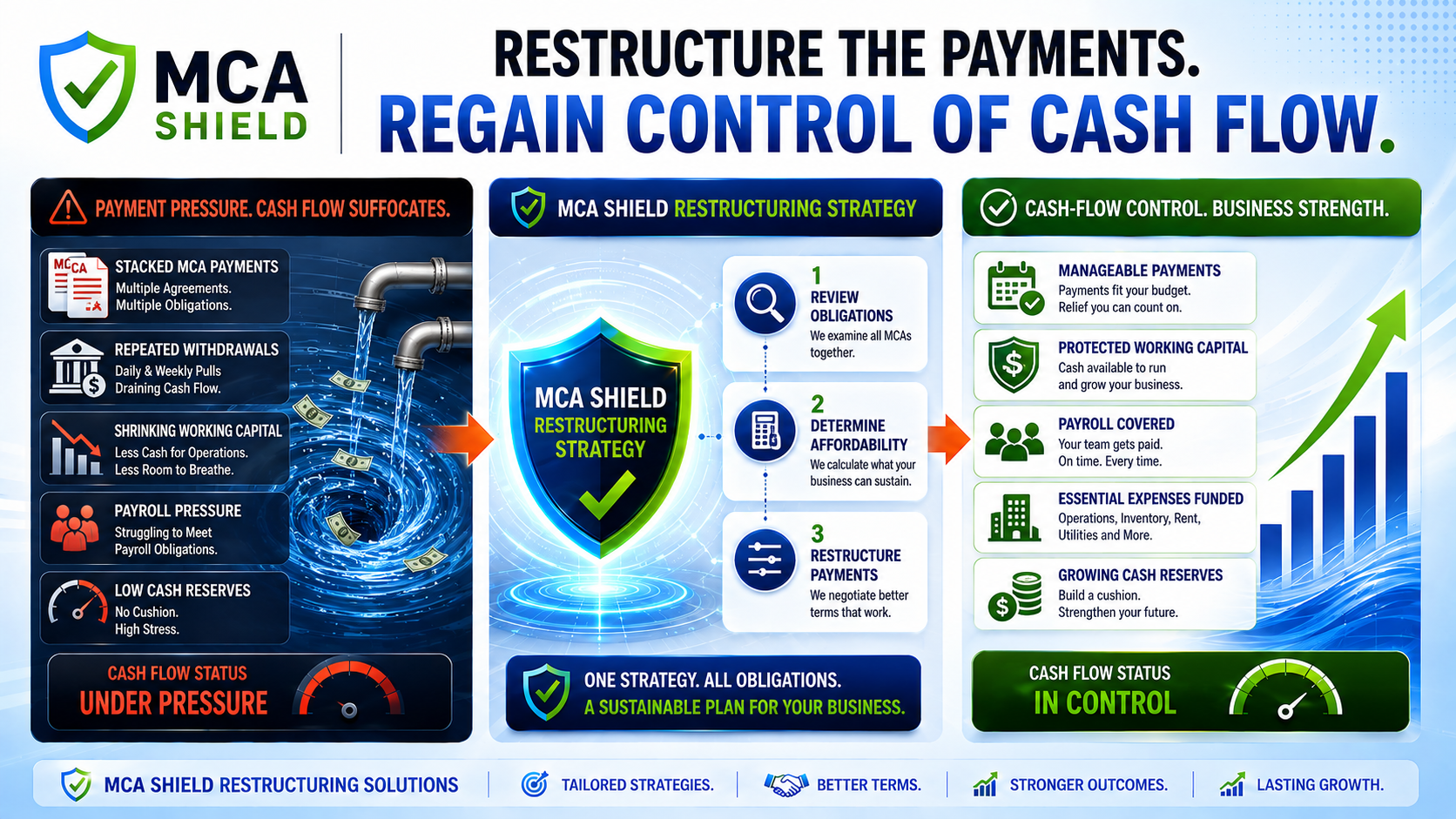
Starting the MCA restructuring process begins with understanding exactly where your business stands. Before discussing new payment terms, business owners should have a clear picture of every merchant cash advance, current payment amount, remaining obligation, and overall cash-flow situation.
The goal is to avoid making another short-term decision that creates even more financial pressure. Instead, the business should identify what it can realistically afford and explore whether a more manageable MCA payment structure may be possible.
Gather Your MCA Agreements and Payment Information
The first step is collecting all documents related to your current merchant cash advances.
For each MCA, gather:
- The original merchant cash advance agreement
- Current balance or remaining obligation
- Daily or weekly payment amount
- Payment frequency
- Recent payment history
- Bank statements showing MCA withdrawals
- Any notices or recent communication from the funder
If your business has multiple advances, include information for every active MCA. Looking at only one agreement may not show the true amount of pressure being placed on your cash flow.
It is also helpful to calculate the total amount being withdrawn each day or week. This number provides a clearer picture of how much business revenue is being committed to MCA payments before other expenses are covered.
Having this information organized can make the restructuring review more efficient and help identify where the greatest payment pressure exists.
Understand What Your Business Can Realistically Afford
The next step is determining how much your business can realistically devote to MCA payments without putting normal operations at risk.
Start by reviewing your average revenue and essential monthly expenses. These may include payroll, rent, utilities, taxes, insurance, inventory, supplies, and vendor payments.
Then consider how much working capital must remain available to operate the business safely.
An affordable payment should not require the company to repeatedly delay essential bills or borrow additional money just to make the next withdrawal.
This is a critical part of MCA restructuring because a revised payment only provides meaningful relief if the business can sustain it.
Business owners should also leave room for normal changes in revenue. A payment that works during the strongest sales month may become difficult during a slower period. Building a realistic budget can help establish a payment range that supports both the MCA obligations and the long-term health of the business.
Schedule a Free Consultation With MCA Shield
If MCA payments are consuming too much working capital, you do not have to wait until the situation becomes critical to review your options.
MCA Shield can review your merchant cash advance obligations, current payments, and business cash flow to help you better understand what restructuring options may be available.
For businesses with multiple MCAs, the review can also examine the total payment burden instead of looking at each advance separately. This can help identify whether a coordinated strategy may provide a more sustainable path forward.
The earlier you understand your financial position, the more informed your next decision can be.
Schedule a Free Consultation With MCA Shield to review your current MCA agreements and explore strategies designed to reduce payment pressure, protect working capital, and help your business regain greater control of its cash flow.