

ClickCease
Explore options for your business’s MCA payments.Call (918) 608-0117

High merchant cash advance withdrawals can quickly squeeze the money a business needs to operate. If MCA payments are taking too much from daily or weekly revenue, it may be time to review whether the current payment still fits the business.

Knowing when to ask for lower MCA payments can help you act before cash flow problems become more serious. Warning signs may include difficulty covering payroll, delayed vendor payments, frequent overdrafts, or using new financing just to keep up with existing MCA withdrawals.

The goal is not simply to lower a payment. It is to create a repayment structure that better matches actual business revenue, essential expenses, and available working capital. Understanding your numbers can help you decide when to request a payment adjustment, restructuring, consolidation, or another MCA relief strategy.

Schedule Your Free Consultation

When Should You Ask for Lower MCA Payments?

You should consider asking for lower MCA payments when the current withdrawal begins putting too much strain on your cash flow. The right time to act is often before the business falls behind on essential expenses or misses an MCA payment.

A payment that once seemed manageable can become difficult if revenue changes, expenses increase, or multiple advances are stacked together. Reviewing the situation early may give you more options for reducing the payment and protecting the money needed to keep the business operating.

Before MCA Withdrawals Begin Affecting Essential Expenses

One of the clearest warning signs is when MCA withdrawals start competing with payroll, rent, taxes, inventory, utilities, or vendor payments. These expenses are critical to normal business operations and should not constantly be squeezed by an aggressive repayment schedule.

If you are moving money between accounts, delaying bills, or waiting for new deposits just to cover the next withdrawal, the payment may already be too high. At that point, it can make sense to review your agreements, current balances, and cash flow to determine whether a lower MCA payment is realistic.

Acting early can also help protect working capital. The goal is to avoid a situation where every incoming dollar immediately leaves the business before essential expenses are covered.

When the Current Payment No Longer Matches Business Revenue

MCA payments are usually based on the financial condition of the business at the time the advance was approved. However, revenue can change. Seasonal slowdowns, lost customers, higher operating costs, or unexpected expenses can make the original payment difficult to maintain.

If your current withdrawal no longer reflects what the business can realistically afford, it may be time to ask for lower MCA payments based on actual cash flow. Start by comparing current revenue with essential expenses and the total amount being withdrawn each day or week.

A workable payment should leave enough cash available to operate the business. If the MCA withdrawal is consistently taking money needed for payroll, vendors, taxes, or normal operating expenses, the repayment structure may need to be reviewed.

What Are the Warning Signs Your MCA Payments Are Too High?

Business owner reviewing payroll pressure vendor delays low account balance overdraft risk and high daily MCA withdrawals before cash flow gets worse

High MCA payments do not always become a problem overnight. In many cases, the warning signs appear gradually as more of the business’s revenue is used to cover daily or weekly withdrawals.

If MCA payments are leaving too little cash for normal operations, it may be time to review the payment structure. The sooner you recognize the signs, the more time you may have to explore options for lower MCA payments before cash flow gets worse.

Payroll and Vendor Payments Are Becoming Difficult

Payroll and vendor payments are two of the most important obligations a business must manage. If MCA withdrawals are making it harder to pay employees or suppliers on time, the payment may be taking too much from available cash flow.

You may notice that payroll requires last-minute transfers, vendor invoices are being delayed, or important purchases are being pushed back. These are signs that MCA withdrawals are competing with essential business expenses.

A repayment plan should not leave the business constantly choosing between the MCA payment and the expenses needed to stay open.

Your Business Account Is Frequently Running Low

Another warning sign is a business bank account that is regularly close to empty after MCA withdrawals are processed.

Frequent low balances can lead to overdraft fees, returned payments, delayed bills, and greater cash flow pressure. Even if the business is still making every MCA payment, the current withdrawal may not be sustainable if there is little operating cash left afterward.

Review how much money remains after each daily or weekly withdrawal. If the account repeatedly falls to a level that makes normal expenses difficult to cover, it may be time to ask for lower MCA payments.

You Are Using New Financing to Cover Existing MCA Payments

Using new financing to keep up with existing MCA payments is one of the strongest warning signs that the current structure may be too expensive.

A new advance can provide temporary cash, but it may also add another payment to the business. This can create a cycle where new financing is used to support old financing, causing total withdrawals to grow instead of solving the underlying cash flow problem.

If you are considering another MCA simply to cover current payments, review the existing agreements first. A strategy focused on reducing the current payment burden may be more sustainable than adding another daily or weekly withdrawal.

Should You Ask for Lower MCA Payments When Revenue Drops?

Business owner comparing original revenue current revenue high MCA payments and cash flow gap during an affordable payment review

A drop in revenue can quickly make an existing MCA payment harder to manage. If the business is bringing in less money but the same daily or weekly amount is still being withdrawn, cash flow can tighten fast.

This is often a good time to review whether the current payment still matches the business. Asking for lower MCA payments may be appropriate when revenue has fallen enough that the existing withdrawal is interfering with normal operations.

Compare Current Revenue With the Revenue Used to Set the Original Payment

Start by comparing your current business revenue with the revenue level that existed when the MCA payment was established. If sales have dropped significantly, the original payment may no longer reflect what the business can comfortably support.

Look at recent bank deposits, monthly revenue, and the amount being withdrawn for MCA payments. This comparison can help show whether the current payment has become too large relative to the money coming into the business.

If revenue has changed, it may be worth reviewing whether reconciliation, restructuring, negotiation, or another payment adjustment is available under the agreement.

Determine What the Business Can Realistically Afford

Before asking for a lower payment, calculate what the business can actually afford after essential expenses are covered.

Review payroll, rent, taxes, vendors, utilities, inventory, and other necessary operating costs. Then determine how much cash is reasonably available for MCA payments without putting the business at risk.

A lower payment should be based on real cash flow, not guesswork. The goal is to create a payment structure that allows the business to meet its MCA obligations while still keeping enough money available to operate.

Can You Lower MCA Payments Before You Default?

Yes. In many cases, it is better to explore lower MCA payments before a default occurs rather than waiting until the business has already missed withdrawals or triggered collection activity.

If the current payment is becoming difficult to maintain, acting early can give you more time to review the agreement, understand the available options, and determine whether a different payment structure may be possible.

Why Acting Before a Missed Payment Can Matter

A missed payment can change the situation quickly. Depending on the agreement, default may lead to collection pressure, additional fees, UCC-related issues, or enforcement of other contract terms.

That is why it can be helpful to review the problem while the business is still making payments. If you already know the current withdrawal is becoming unsustainable, waiting until the account fails may reduce your flexibility.

The goal is to identify the issue early and explore whether reconciliation, payment negotiation, restructuring, or another MCA relief strategy can reduce the pressure before the business reaches a crisis point.

Gather Your Agreements, Balances, and Cash-Flow Information First

Before requesting lower MCA payments, organize the financial information needed to understand the full situation.

Start with your MCA agreements, remaining balances, current daily or weekly withdrawals, recent bank statements, revenue, and essential operating expenses. This information helps create a clearer picture of what the business is actually able to afford.

You should also identify any UCC filings, personal guarantees, default provisions, or collection terms connected to the agreements. A complete review makes it easier to compare your options and build a payment strategy around the business’s real cash flow and operating needs.

Should You Ask for Lower Payments on Multiple Stacked MCAs?

Multiple stacked MCAs can place far more pressure on cash flow than a single advance. Each agreement may have its own daily or weekly withdrawal, and the combined total can quickly become difficult to manage.

If several funders are pulling money from the business at the same time, it may be worth exploring lower MCA payments before the withdrawals begin affecting payroll, vendors, taxes, or other essential expenses.

Calculate the Total Daily or Weekly Withdrawal Burden

Start by adding together every MCA withdrawal being taken from the business.

Do not look at each payment separately. The more important number is the total amount leaving the account each day or week.

For example, several smaller payments may appear manageable on their own. However, once combined, they may consume a large share of business revenue.

Compare the total withdrawal amount with recent deposits and monthly revenue. This can help you determine whether stacked MCA payments are taking more cash than the business can realistically support.

Look at the Combined Effect on Working Capital

Working capital is the money the business needs to handle normal operations. When multiple MCA withdrawals reduce that cash too aggressively, the business may struggle to cover payroll, inventory, vendors, taxes, rent, and other operating costs.

Stacked MCAs can also make cash flow harder to predict. One strong sales day may temporarily improve the account balance, only for several withdrawals to reduce it again.

If the combined payments are consistently leaving too little money available to operate, it may be time to review restructuring, consolidation, negotiation, or another MCA relief strategy. The goal is to reduce the overall payment burden and create a structure that better fits the business’s actual cash flow.

What Options Can Help Lower MCA Payments?
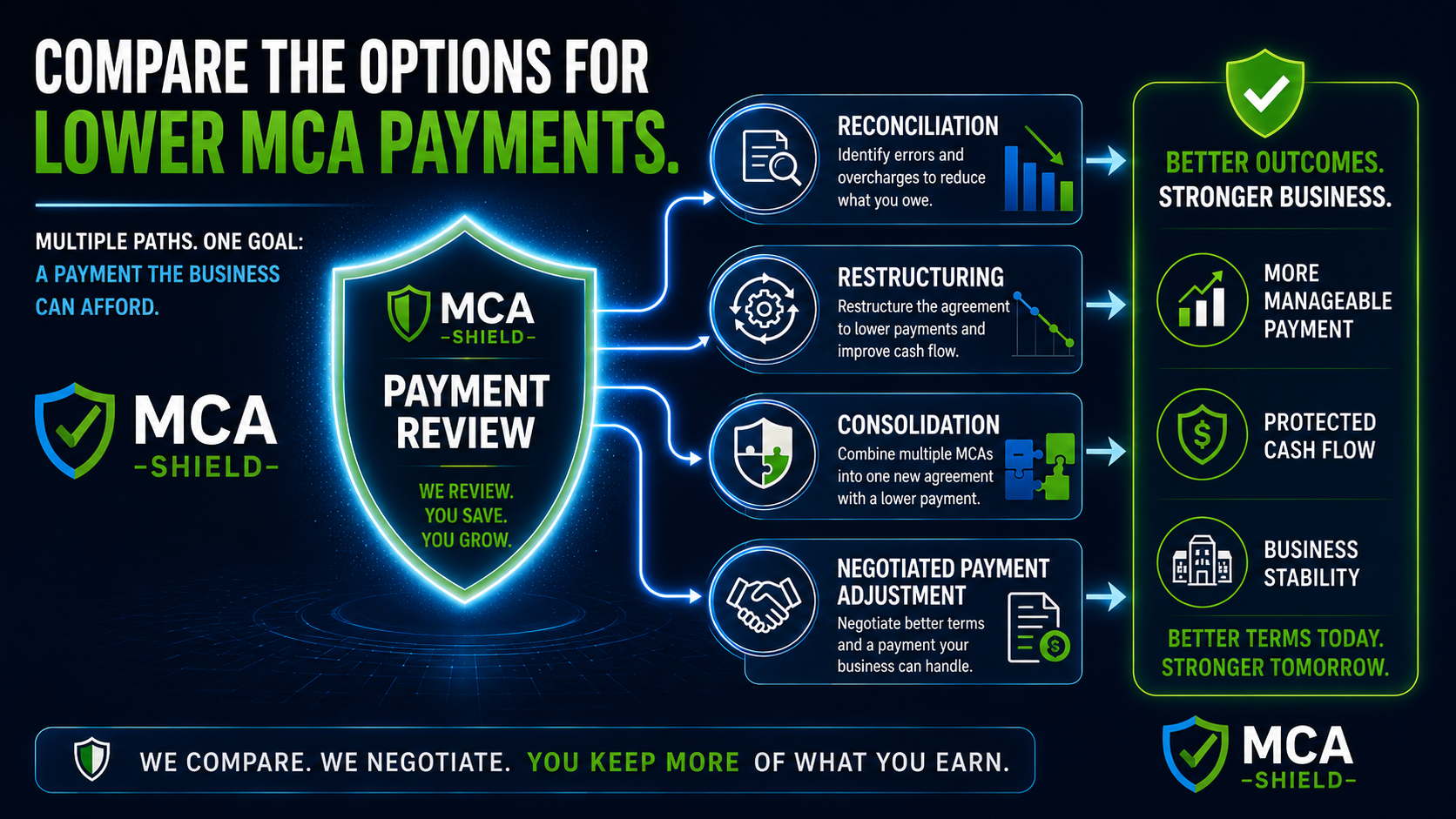
MCA Shield payment review comparing reconciliation restructuring consolidation and negotiated payment adjustment options for lower MCA payments

There is more than one way to pursue lower MCA payments. The right option depends on the agreement, the remaining balance, current revenue, and how much the business can realistically afford.

Before choosing a strategy, review the full financial picture. That includes current withdrawals, essential operating expenses, available working capital, and any terms that may affect a payment change.

Reconciliation or Payment Adjustment

Some MCA agreements include a reconciliation provision that may allow the payment to be adjusted when business revenue changes.

If revenue has dropped, the business may be able to request a review based on actual receipts or bank deposits. This can help determine whether the current withdrawal should be reduced to better reflect present cash flow.

The exact process depends on the agreement. Review the required documentation, deadlines, and calculation method before requesting a payment adjustment.

MCA Restructuring or Consolidation

MCA restructuring may change the repayment schedule so the business has a more manageable daily or weekly payment. The goal is to reduce immediate cash flow pressure while creating a payment plan the business can realistically maintain.

MCA consolidation may also be considered when a business has multiple stacked advances. Instead of managing several separate withdrawals, a consolidation strategy may combine or reorganize the payment burden into a more manageable structure.

Before agreeing to either option, compare the new payment, total repayment amount, fees, repayment length, and written terms.

Negotiating a New Payment Arrangement

Another option is to negotiate directly for a different payment structure. This may involve requesting a lower withdrawal, longer repayment period, temporary reduction, or other revised terms.

A stronger negotiation usually begins with accurate financial information. Be prepared to show current revenue, essential expenses, remaining MCA balances, and what the business can reasonably afford.

Most importantly, make sure any new arrangement is confirmed in writing. A lower payment should provide real cash flow relief while giving the business a realistic path to complete the repayment plan.

What Should You Review Before Agreeing to a Lower MCA Payment?

A lower payment can provide immediate relief, but the new payment amount is only one part of the decision. Before agreeing to revised MCA terms, review the entire structure to make sure it supports the business over time.

The goal should be to reduce cash flow pressure without creating a repayment plan that becomes expensive, confusing, or difficult to complete.

Compare the New Payment With Your Available Cash Flow

Start by comparing the proposed payment with the amount of cash the business actually has available after essential expenses.

Review revenue, payroll, rent, taxes, vendors, inventory, utilities, and other operating costs. Then determine whether the new daily or weekly withdrawal leaves enough money for normal business activity.

A payment may be lower than before and still be too high. The best structure is one that fits the business’s real cash flow and working capital needs.

Review the Total Repayment Cost and Length of the Plan

A lower payment can sometimes come with a longer repayment period or additional costs. That is why it is important to look beyond the monthly, weekly, or daily amount.

Review the remaining balance, total repayment amount, fees, repayment schedule, and expected length of the plan. Compare those numbers with the current arrangement before making a decision.

A strong MCA relief strategy should improve cash flow while also giving the business a realistic path toward completing the obligation.

Get the New Terms in Writing

Never rely only on a verbal promise that the payment will change.

Any revised arrangement should clearly state the new payment amount, payment frequency, effective date, remaining balance, fees, and other important terms. If the agreement affects default provisions, UCC filings, personal guarantees, or collection activity, those details should also be reviewed carefully.

Having the terms in writing helps prevent confusion and gives the business a clear record of the new repayment structure.

When Is Lowering MCA Payments Better Than Taking Another Advance?

Taking another merchant cash advance may seem like a quick way to solve a cash flow problem. However, new funding can also add another daily or weekly withdrawal to an already strained business.

If the main problem is that existing MCA payments are too high, it may make more sense to explore lower MCA payments before adding another obligation. The goal should be to improve cash flow, not simply create more money coming in while even more money goes back out.

Avoid Using New MCA Funding Just to Cover Existing Withdrawals

Using a new advance to make existing MCA payments can create a difficult cycle. The business receives fresh capital, but part of that money may immediately be used to cover older withdrawals.

This can increase the total repayment burden and make it harder to keep enough cash available for payroll, vendors, taxes, inventory, and other operating expenses.

If new funding is mainly being considered because current MCA payments are unaffordable, review the existing agreements first. A strategy that reduces the current burden may be more sustainable than adding another payment.

Focus on Reducing the Existing Cash-Flow Burden

When cash flow is already tight, the better question may be how to reduce the amount leaving the business.

Review the total MCA balances, current withdrawals, revenue, and essential expenses. Then compare options such as reconciliation, restructuring, consolidation, or payment negotiation.

A well-structured plan should aim to create more manageable MCA payments while protecting the cash the business needs to operate. Reducing the existing burden can help create a stronger foundation than relying on repeated advances to keep up with old ones.

Ask for Lower MCA Payments Before Cash Flow Gets Worse

Business owner reviewing MCA agreements balances withdrawals revenue and expenses to build lower payments and stronger cash flow

Waiting too long can make an MCA problem harder to solve. If daily or weekly withdrawals are already cutting into essential expenses, it may be time to review the payment before cash flow becomes more difficult to manage.

The goal is to create lower MCA payments that fit the business, not simply delay the problem. Acting earlier can give you more time to compare options, review agreements, and build a repayment strategy around the numbers the business can realistically support.

Build the Payment Around the Cash Flow Your Business Actually Has

A workable MCA payment should reflect actual revenue, essential expenses, and available working capital.

Start by reviewing current deposits, operating costs, MCA balances, and total withdrawals. Then determine how much the business can afford to pay without putting payroll, vendors, taxes, or normal operations at risk.

The right strategy may involve reconciliation, restructuring, consolidation, or payment negotiation. The important part is choosing a payment structure the business has a realistic chance of completing.

Schedule a Free Consultation With MCA Shield

If MCA withdrawals are taking too much from your business, MCA Shield can review your current agreements, balances, payments, and cash flow to help identify possible relief options.

The objective is to understand the full financial picture and determine whether a more manageable payment structure may be available.

Schedule a free consultation with MCA Shield to review your situation and explore a strategy designed to protect cash flow, working capital, and the money your business needs to keep operating.